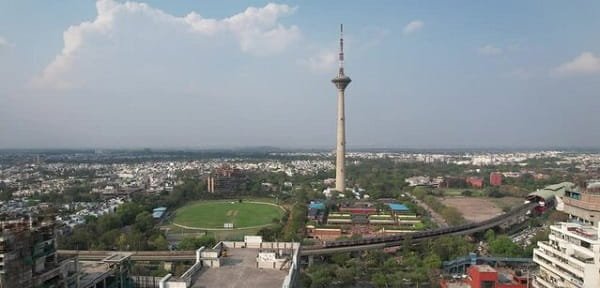
New Delhi, as the capital of India, hosts several important broadcasting and communication landmarks. Among them, the TV Tower New Delhi—commonly known as the Pitampura TV Tower—stands out as a major public broadcasting structure. Built to support television transmission for the national broadcaster, this tower plays a crucial role in communication infrastructure across Delhi.
Constructed in 1988, the tower remains one of the tallest structures in Delhi and a key part of the city’s skyline. Moreover, it represents the growth of broadcasting technology in India during the late 20th century. As a result, the TV Tower continues to hold both functional and landmark importance.
| Feature | Details |
| Location | Pitampura, New Delhi |
| Type | Public (Broadcasting Tower) |
| Height | 235 meters |
| Built Year | 1988 |
| Owner | Prasar Bharati (Doordarshan) |
| Usage | Television transmission |
| Structure | Reinforced concrete tower |
| Status | Operational |
Location Advantage
The TV Tower is strategically located in Pitampura, a well-developed residential and commercial area in North-West Delhi. Because of this positioning, it ensures wide broadcast coverage across the city.
Additionally, Pitampura is surrounded by residential colonies, markets, and educational institutions. This makes the tower easily recognizable and accessible within the locality.
Moreover, the location allows effective signal transmission due to its height and central placement within the region. As a result, it serves both functional and landmark purposes.
Connectivity and Transportation
Connectivity remains one of the strongest advantages of the TV Tower. The area is well-connected through major roads such as Outer Ring Road, which links various parts of Delhi.
In addition, metro connectivity via Pitampura Metro Station and nearby stations on the Red Line provides easy access to the location.
Moreover, public transport options such as buses, autos, and taxis operate frequently in the area. The Indira Gandhi International Airport is also accessible via major road networks.
Consequently, visitors and maintenance personnel can reach the tower easily.
Nearby Places and Landmarks
The TV Tower is surrounded by several important landmarks that enhance its public significance. For instance, Netaji Subhash Place (NSP) is a major commercial hub located nearby.
Additionally, District Park Pitampura provides a recreational space for residents. Shopping centers, schools, and hospitals are also located within close proximity.
Moreover, nearby residential areas such as Rohini and Shalimar Bagh contribute to the area’s urban activity. As a result, the tower remains a prominent feature in a busy locality.
How to Reach TV Tower New Delhi
Reaching the TV Tower is straightforward due to its strong connectivity:
- By Road: Accessible via Outer Ring Road and local roads in Pitampura
- By Metro: Nearest station is Pitampura Metro Station (Red Line)
- By Rail: New Delhi Railway Station is reachable via metro or road
- By Air: Indira Gandhi International Airport is accessible by car or metro
- By Public Transport: Buses, autos, and taxis are widely available
Thus, the tower remains easily accessible within Delhi.
Architectural Design and Structure
The TV Tower features a reinforced concrete structure designed for broadcasting purposes. Standing at approximately 235 meters, it is among the tallest structures in Delhi.
Moreover, the tower includes a shaft with multiple platforms that support transmission equipment and antennas. The design ensures stability and efficient signal coverage.
Additionally, the tower incorporates safety features and maintenance access systems. Therefore, it meets the technical requirements of broadcasting infrastructure.
Broadcasting Importance
The TV Tower plays a vital role in broadcasting television signals across Delhi. It is operated by Prasar Bharati, which manages Doordarshan, India’s national television network.
Moreover, the tower was built to enhance signal strength and coverage during a time when television broadcasting was expanding rapidly in India.
As a result, it contributed significantly to the growth of mass communication in the country. Therefore, it remains an important part of India’s broadcasting history.
Public and Landmark Value
Although primarily a functional structure, the TV Tower also serves as a landmark in Delhi. Its height and unique design make it visible from various parts of the city.
Moreover, it has become a point of reference for navigation and local identity in Pitampura. As a result, it holds both technical and symbolic importance.
Future Outlook
The future of the TV Tower remains stable as broadcasting continues to evolve. While digital platforms are expanding, transmission towers still play a crucial role in communication infrastructure.
Moreover, upgrades in technology may further enhance its functionality. Consequently, the tower will continue to serve as a key broadcasting facility.
Final Thoughts
TV Tower New Delhi represents a significant milestone in India’s broadcasting and communication infrastructure. With its strategic location in Pitampura, strong connectivity, and technical importance, it continues to support television transmission across the city. Furthermore, the tower highlights how public infrastructure can shape urban identity. Therefore, the TV Tower remains an important landmark in New Delhi.
FAQs
Q: Where is the TV Tower located in Delhi?
A: It is located in Pitampura, New Delhi.
Q: What is the height of the TV Tower?
A: It is approximately 235 meters tall.
Q: What is the purpose of the TV Tower?
A: It is used for broadcasting television signals.
Q: Who operates the TV Tower?
A: It is operated by Prasar Bharati (Doordarshan).
Q: How can I reach the TV Tower?
A: You can reach it by road, metro (Pitampura), or taxi.
Q: Is the TV Tower open to the public?
A: No, it is primarily a functional broadcasting structure.
Q: Why is the TV Tower important?
A: It plays a key role in television transmission and communication infrastructure in Delhi.